

3.2 JSONPath Runtime Extractions & Body Assertions
How to extract dynamic tokens using JSONPath and assert on response body structures.
Example: a booking lifecycle
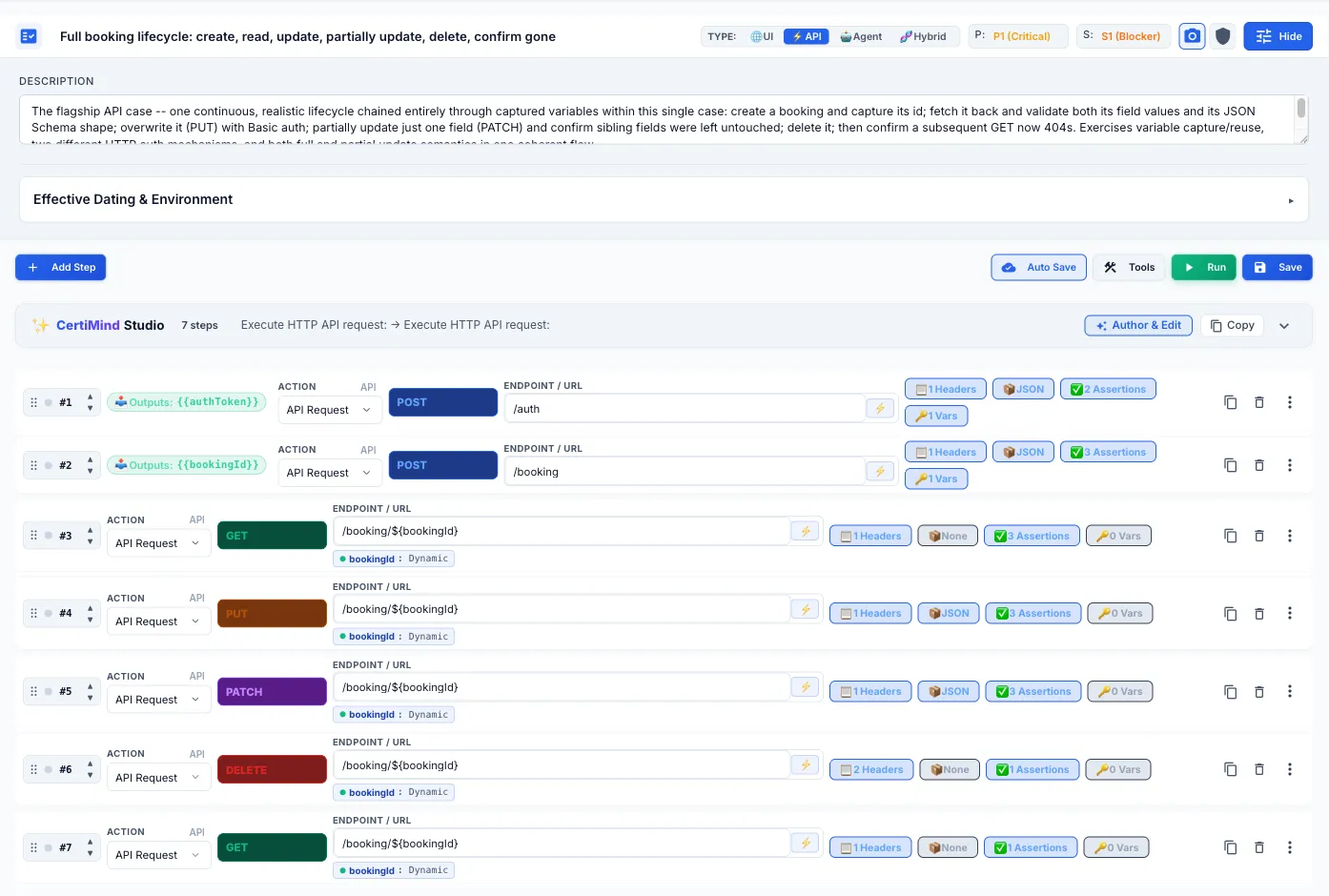
Section titled “Example: a booking lifecycle”This case runs against restful-booker, a public practice API. It creates a booking, reads it back, updates it, deletes it, and confirms it is gone. Each request captures values (the auth token and the booking id) and passes them to the next, and each response is checked with status and JSONPath assertions.
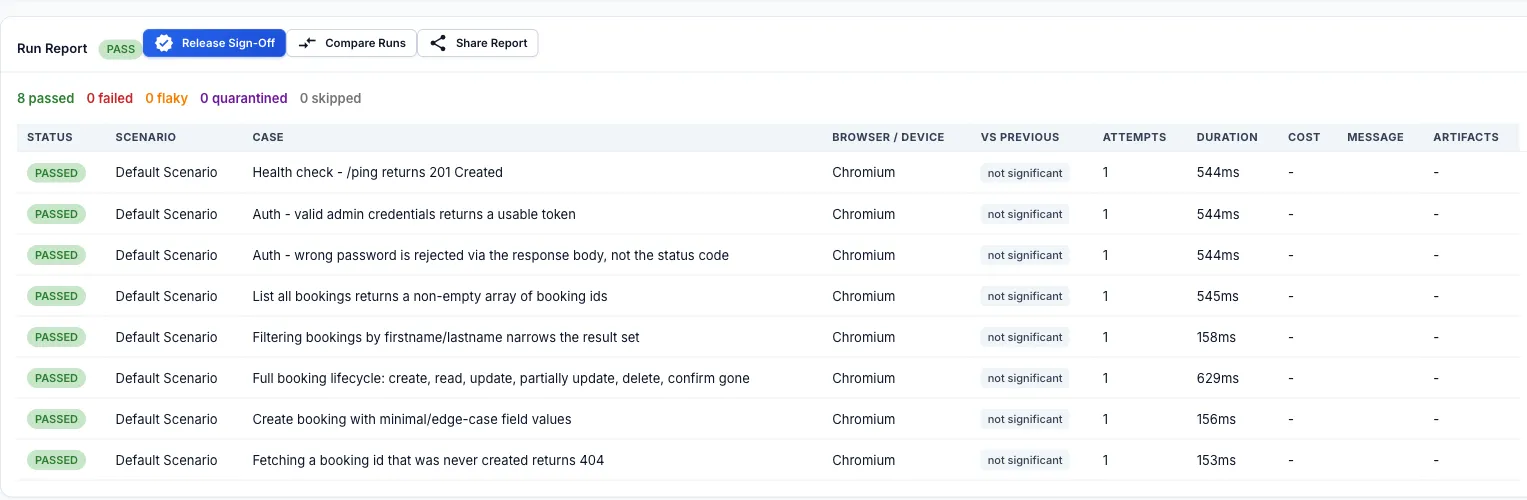
Running the suite produces one report. All eight cases pass.
One Step, Two Jobs: Extracting and Asserting
Section titled “One Step, Two Jobs: Extracting and Asserting”An API Request step doesn’t hand extraction and assertion off to separate step types – both live as sub-lists on the same step, in the Vars and Assertions tabs from 4.1. The Vars tab holds variable captures: give a capture a variable name and a source (JSON_PATH, XPATH, HEADER, STATUS_CODE, or BODY_RAW) and an expression, and CertiQA pulls that value out of the response the instant it arrives, ready for {{ that variable }} to be referenced by any step later in the case. A capture also takes an optional default value, used only when the expression doesn’t resolve – so a step reaching for {{ orderId }} two steps later gets a safe fallback instead of an undefined-variable failure when, say, a response occasionally omits the field on a retry.
JSONPath expressions use the familiar $.field.nested syntax – $.data.orderId, items[0].id, results[*].status – resolved against the parsed response body. The Assertions tab is the same idea aimed at pass/fail instead of variable capture: each rule names a target, an operator, and an expected value, and every rule on a step must pass for the step itself to pass.
| Assertion Target | Checks | Typical Operators |
|---|---|---|
| STATUS_CODE | The numeric HTTP response status. | EQUALS, GREATER_THAN, LESS_THAN |
| JSON_PATH | A value at a JSONPath expression, e.g. $.status. | EQUALS, CONTAINS, EXISTS, NOT_EXISTS |
| HEADER | A specific response header value. | EQUALS, CONTAINS |
| RESPONSE_TIME | Round-trip latency in milliseconds. | LESS_THAN |
| JSON_SCHEMA | The entire response body validated against a JSON Schema document. | SCHEMA_VALID |
- 📊 Data-Driven Testing (DDT) — Running the same chained request-and-assertion case once per row of a dataset instead of once per test.